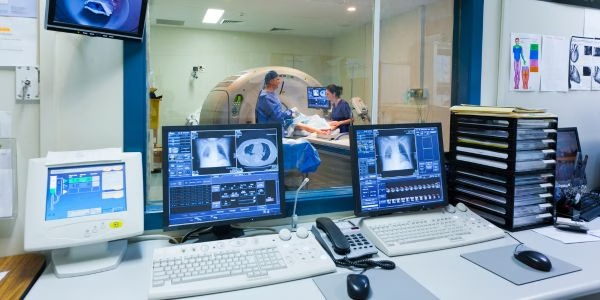
Did Your Doctor Find Every Injury After Your Crash?
Most patients assume the answer is yes.
If you went to the emergency room, visited your family doctor, or started treatment shortly after a crash, it is natural to believe that every injury was found and documented.
Unfortunately, that does not always happen.
Some crash-related injuries are easy to see right away. Others are more difficult to identify. Some do not show up clearly on standard imaging. Some symptoms develop days later. And sometimes the evaluation simply does not go far enough to identify the full extent of the injury.
That is why one of the biggest problems after a crash is not always overtreatment.
It is missed injuries.
Why Some Injuries Are Missed
After a crash, the first priority is making sure you do not have a life-threatening emergency. Emergency rooms are very important for identifying serious problems such as fractures, bleeding, severe trauma, or urgent neurologic concerns.
But an emergency visit is not the same thing as a complete injury evaluation.
Many crash injuries involve muscles, ligaments, joints, discs, nerves, and soft tissues. These injuries may not be obvious during the first visit. They may also require a more detailed examination to understand what is actually causing the pain.
A patient may be told that nothing serious was found, but still have real injuries that need further evaluation.
Pain Is Not the Same as a Diagnosis
There is a big difference between naming where you hurt and identifying what was injured.
“Neck pain” is not really an injury diagnosis. It is a symptom.
“Back pain” tells us where you hurt, but it does not fully explain why you hurt.
A proper injury evaluation should look deeper. The goal is to identify what structures may have been injured, how those injuries are affecting movement and function, and what treatment may be appropriate.
If the diagnosis is too vague, the treatment plan may also be too vague.
Why Missed Injuries Matter
An injury that is never identified can create several problems.
It may not be treated properly. It may not be tracked over time. It may not be connected to your daily limitations. And it may not be documented clearly in your medical record.
That matters because your medical record should tell the story of your injury and recovery.
If important injuries are missing from the record, it can become harder to understand why you continue to have symptoms, why treatment is needed, or why certain activities remain difficult.
The problem is simple: if the injury is never found, it is much harder to manage.
Not Every Provider Evaluates Crash Injuries the Same Way
Patients often assume that all healthcare providers look for the same injuries in the same way.
They do not.
Some providers focus mainly on pain relief. Some focus on ruling out emergencies. Some perform a more detailed injury evaluation designed to identify specific diagnoses, functional loss, movement problems, and long-term concerns.
That difference matters after a crash.
A provider who does not regularly evaluate crash injuries may not look for the same problems as a provider who works with these injuries every day. This does not mean the first provider did anything wrong. It means the type and depth of evaluation can be very different.
Why Documentation Is Part of Recovery
Good documentation is not just paperwork.
It helps your healthcare team understand:
Where you hurt
What injuries were found
How your symptoms changed over time
What daily activities became difficult
How you responded to treatment
Whether symptoms improved, worsened, or persisted
Whether further evaluation may be needed
When documentation is specific and complete, it helps guide care. When it is vague or incomplete, important details can be lost.
Daily Activities Tell an Important Story
After a crash, one of the most important questions is not just, “Where does it hurt?”
It is also, “What can you no longer do normally?”
Crash injuries may affect your ability to:
Work
Drive
Sleep
Exercise
Lift your children
Do laundry
Clean your house
Sit or stand for long periods
Enjoy hobbies or recreation
These details matter because they show how the injury is affecting your real life. If those problems are not documented, the medical record may not accurately reflect what you are going through.
When Ongoing Symptoms Need a Closer Look
You may need a more detailed evaluation if:
You were told nothing was wrong, but you still have pain
Your symptoms are not improving
Your symptoms are getting worse
You developed new symptoms after the crash
You are having headaches, dizziness, neck pain, back pain, numbness, or weakness
Daily activities are still difficult
You feel like your injuries were never fully explained
Persistent symptoms should not be ignored simply because the first evaluation did not find everything.
The Bottom Line
After a crash, the question is not only whether you were checked.
The better question is whether your injuries were fully identified, clearly diagnosed, and properly documented.
Missed injuries can affect treatment, recovery, documentation, and your understanding of what happened to your body. A thorough evaluation can help identify problems that may have been overlooked and create a clearer plan for recovery.
If you were injured in a collision and still have pain, limitations, or unanswered questions, Billings Chiropractic Injury Clinic / Auto Injury Center can help evaluate your condition and document your recovery clearly.

About the Author
Dr. Jeff Mitchell, DC, CICE
Dr. Mitchell is a speaker, coach, researcher, and treating physician for victims of car crashes. At Billings Chiropractic Injury Clinic, he’s dedicated his 20+ year career to helping people heal fully, not just “patch the pain.”